Medical emergency? Call your local emergency number
First aid guides

Menu

External fixation as a temporary bridge to permanent surgical bone repair

External fixation as a temporary bridge to permanent surgical bone repair Orthopaedics & bone 4 min read
Not yet medically reviewed. This page has not been checked by a qualified medical reviewer. Use it for general education only and confirm anything important with a healthcare professional. Written by GeoMed Editorial Team. Last updated 24 October 2026.
Every patient and hospital is different. Your surgical team will explain what applies to you, including the benefits, risks and alternatives, before asking for your consent.

Here's a sobering reality that keeps trauma surgeons awake at night: 100% of polytrauma patients treated with external fixation survived their initial injuries in a recent study, yet many practitioners still hesitate to use this life-saving technique as a temporary bridge to definitive care. That statistic alone should make every orthopedic surgeon reconsider their approach to damage control orthopedics. The operating room is chaotic. Your patient arrives with multiple injuries, unstable vitals, and a mangled lower extremity that demands immediate attention. Do you commit to a lengthy definitive repair that could push an already compromised patient over the edge? Or do you buy time with external fixation, knowing that this temporary solution might just be the difference between life and death?

The Strategic Pause That Saves Lives

External fixation isn't giving up it's playing chess while others play checkers. This temporary stabilization technique has evolved from a last resort into a sophisticated damage control strategy that's revolutionizing trauma care. The numbers don't lie: 38.5% of patients initially treated with external fixation successfully convert to internal fixation, while 23% find that external fixation serves as their definitive treatment.

But here's what the textbooks don't always emphasize: timing is everything. The sweet spot for conversion lies between 7 and 60 days post-injury, with an average of 12.4 days providing optimal outcomes. Wait too long, and complications multiply. Move too fast, and you're operating on compromised tissue.

The Clinical Reality Check

Let's address the elephant in the room complications. Pin tract infections remain the most common concern, affecting up to 24.2% of patients when fixators remain in place for 43-90 days. However, this drops to 19.6% when removed within 42 days. These aren't just statistics; they represent real patients whose outcomes depend on your clinical decision-making.

The data reveals a clear pattern:

  • Gustilo grade IIIa fractures: 8.8% infection rate, 2.9% nonunion rate

  • Gustilo grade IIIb fractures: 25% infection rate, 33% nonunion rate

This dramatic difference underscores a critical principle: external fixation works brilliantly for grade IIIa and below, but grade IIIb injuries require a different level of vigilance and often alternative strategies.

The Art of Perfect Timing

Converting from external to internal fixation isn't just about calendar days it's about reading your patient's biology. The key indicators that signal readiness for conversion include:

  • Soft tissue recovery: The wound must show signs of healing without active infection or excessive drainage. Visual inspection remains your best diagnostic tool.

  • Inflammatory markers: C-reactive protein (CRP) should show a downward trend from its peak value. This biochemical signal often precedes visible tissue improvement.

  • Patient stability: Hemodynamic stability and resolution of systemic inflammatory response syndrome (SIRS) are non-negotiable prerequisites.

  • One fascinating finding from recent research: 83% of nonunion cases and two-thirds of infection cases were successfully salvaged with just one additional procedure. This resilience speaks to the robust healing potential that external fixation preserves when used appropriately.
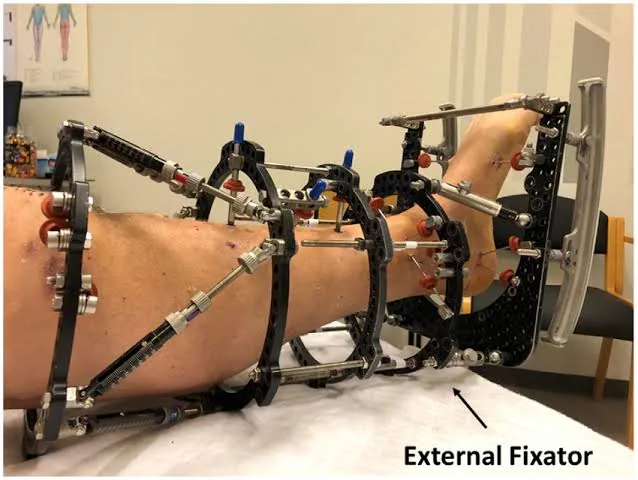
External fixation as a temporary bridge to permanent surgical bone repair

Beyond the Numbers: Clinical Pearls

The most successful conversions happen when surgeons resist the urge to rush. I've observed that the best outcomes occur when three conditions align: the soft tissue envelope has recovered, inflammatory markers are trending downward, and the patient's overall condition permits a more extensive procedure.

Read also: A Simple Glue Could End the Era of Metal Plates in Bone Repair

Consider this approach revolutionary rather than conservative. You're not delaying definitive care you're optimizing the conditions for definitive success. The temporary nature of external fixation allows tissues to recover from the initial trauma while maintaining fracture alignment and preventing further soft tissue compromise.

The Future of Damage Control Orthopedics

External fixation as a bridge to definitive repair represents more than just a treatment option it's a paradigm shift toward biology-respecting trauma care. The technique acknowledges that sometimes the best intervention is the one that gives your patient's body time to prepare for definitive repair.

Recent advances in external fixation systems have made application faster and more precise. Modern quick-connect systems can be applied in minutes rather than the hour-long procedures of the past. This efficiency is crucial in damage control scenarios where every minute counts.
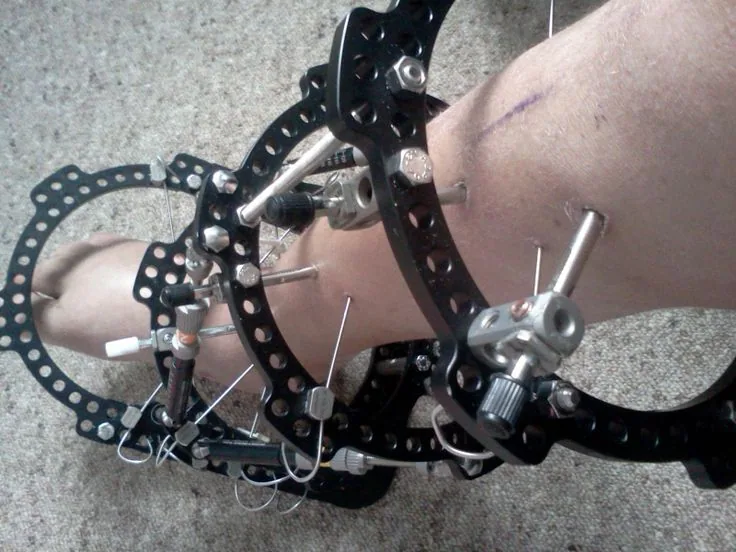
External fixation as a temporary bridge to permanent surgical bone repair

The evidence is compelling: when used judiciously as a temporary bridge, external fixation offers survival rates that should make it a cornerstone of your trauma protocol. The key lies not in avoiding complications they're inevitable in severe trauma but in managing them proactively and converting to definitive care at the optimal moment.
Image credits

  • Heading image: GeoMed

More Surgical procedures

View all
What You Must Know Before Choosing a BBL Procedure for Your Dream Shape Cosmetic & plastic surgery

What You Must Know Before Choosing a BBL Procedure for Your Dream Shape

The Brazilian Butt Lift carries a mortality rate that once reached 1 in 3,000 procedures making it the deadliest cosmetic surgery in plastic surgery history. That shocking statistic alone should make you pause before booking that consultation. But here's what the headlines don't tell you: when performed correctly by a qualified surgeon using modern techniques, the risk drops to less than 1 in 15,000. That's actually safer than a tummy tuck! I've spent years watching this procedure evolve from a high-risk gamble to a genuinely transformative option for patients. And I need you to understand something crucial right from the start: the difference between a safe BBL and a dangerous one often comes down to decisions you make before you ever set foot in an operating room. This isn't about scaring you away from achieving your aesthetic goals. It's about ensuring you walk into this with your eyes wide open, armed with the knowledge that could literally save your life.

8 min read
Why BBL Surgery Has Become the Most Talked About Body Procedure Today Cosmetic & plastic surgery

Why BBL Surgery Has Become the Most Talked About Body Procedure Today

A recent global cosmetic report revealed something striking fat-transfer butt enhancement has grown at a rate faster than almost any other aesthetic procedure in the last decade, and the trend shows no signs of slowing down. That number alone tells us something deeper is happening. People aren’t just chasing curves. They’re chasing confidence, body balance, and a sense of identity shaped by modern culture. I’ve watched the conversations around BBLs evolve from whispers to front-page discussions, and it’s fascinating how a single procedure has reshaped the beauty landscape so dramatically. The buzz isn’t random. It’s rooted in real, powerful reasons that many people don’t fully understand until they take a closer look. Let’s break it down with clarity, honesty, and real value!

5 min read
Why Doctors Prefer Suprapubic Catheters Over Regular Urinary Catheters in Some Cases Urology

Why Doctors Prefer Suprapubic Catheters Over Regular Urinary Catheters in Some Cases

Here's something most people don't realize: roughly one in four hospital patients needs a urinary catheter at some point during their stay. That's millions of people worldwide dealing with bladder drainage, and the decision about which type of catheter to use isn't just medical paperwork it can mean the difference between comfort and pain, between a smooth recovery and a serious infection. I've spent years examining catheterization strategies, and the truth is more nuanced than most healthcare discussions suggest. The traditional indwelling urethral catheter that familiar tube inserted through the urethra isn't always the best option. In fact, for certain patients, a suprapubic catheter might be significantly better. Let me explain why.

6 min read
Breaking Down the Science Behind Successful Artery Replacement Procedures Heart & vascular

Breaking Down the Science Behind Successful Artery Replacement Procedures

In Japan, cardiac surgeons achieve a staggering 99.1% feasibility rate in heart bypass surgery using pioneering guidance technology that eliminates the need for invasive procedures to harvest arterial grafts. Meanwhile, half a world away, American hospitals report that traditional coronary bypass operations maintain an overall success rate of nearly 98% across half a million procedures performed annually. These aren't just impressive statistics they represent a revolution in how we approach one of medicine's most challenging frontiers. I've spent decades watching arterial replacement surgery evolve from high-risk procedures with uncertain outcomes to precision interventions backed by robust science. The transformation has been remarkable, but the real story lies in understanding why some procedures succeed while others fail, and how emerging technologies are rewriting the rules of vascular surgery entirely.

6 min read