Medical emergency? Call your local emergency number
First aid guides

Menu

How to use an inhaler with a spacer

Illustration of a person using an inhaler with a spacer Everyday health skills 1 min read
Not yet medically reviewed. This page has not been checked by a qualified medical reviewer. Use it for general education only and confirm anything important with a healthcare professional. Last updated 26 October 2026.
These tutorials are for general education. Follow the instructions that come with any device or product, and ask a health professional if you are unsure whether something is safe for you.

Get more medicine into your lungs with a pressurised inhaler and a spacer.

What this helps you do

A spacer makes a metered-dose inhaler easier to use and helps more medicine reach the lungs instead of the mouth and throat.

Safety: before you start

Check the inhaler is in date and not empty. Use only the inhalers and doses prescribed for you.

What you will need

  • Your metered-dose (puffer) inhaler
  • A spacer that fits it (with a mask for young children)

Step by step

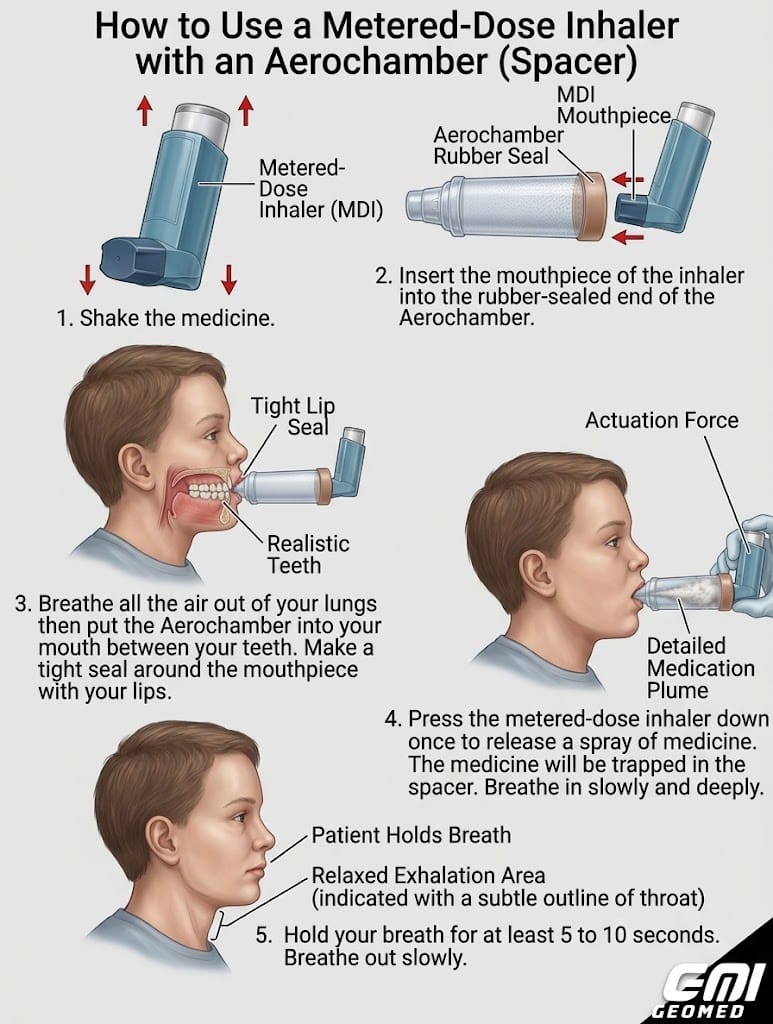
  1. Remove the cap and shake the inhaler well.
  2. Fit the inhaler into the end of the spacer.
  3. Breathe out gently, away from the spacer.
  4. Seal your lips around the mouthpiece (or place the mask over nose and mouth).
  5. Press the inhaler once.
  6. Breathe in slowly and deeply and hold for up to 10 seconds, or take 5 slow normal breaths through the spacer.
  7. Wait about 30 to 60 seconds, shake again and repeat if a second puff is prescribed.IMG-20261026-WA0002 - Removed

Tips and common mistakes

One puff at a time into the spacer. Rinse your mouth after a steroid (preventer) inhaler. Wash the spacer monthly in warm soapy water and let it air dry.

When to stop and get help

Call emergency services if your reliever does not help, you are too breathless to speak, or your lips turn blue.

For students & clinicians (technical detail)

How and why it works

Without a spacer, much of the spray hits the back of the throat. The spacer slows the spray and holds it so you can breathe it in steadily.

Image credits

  • Heading image: BruceBlaus, Wikimedia Commons, CC BY-SA 4.0

References

  1. Health topics. World Health Organization. Citation not yet verified
  2. Medical Devices. U.S. Food and Drug Administration. Citation not yet verified