

HYDROCEPHALUS
 4 min read
Not yet medically reviewed.
This page has not been checked by a qualified medical reviewer. Use it for general education only and confirm
anything important with a healthcare professional.
Last updated 12 November 2026.
Hydrocephalus
More detail
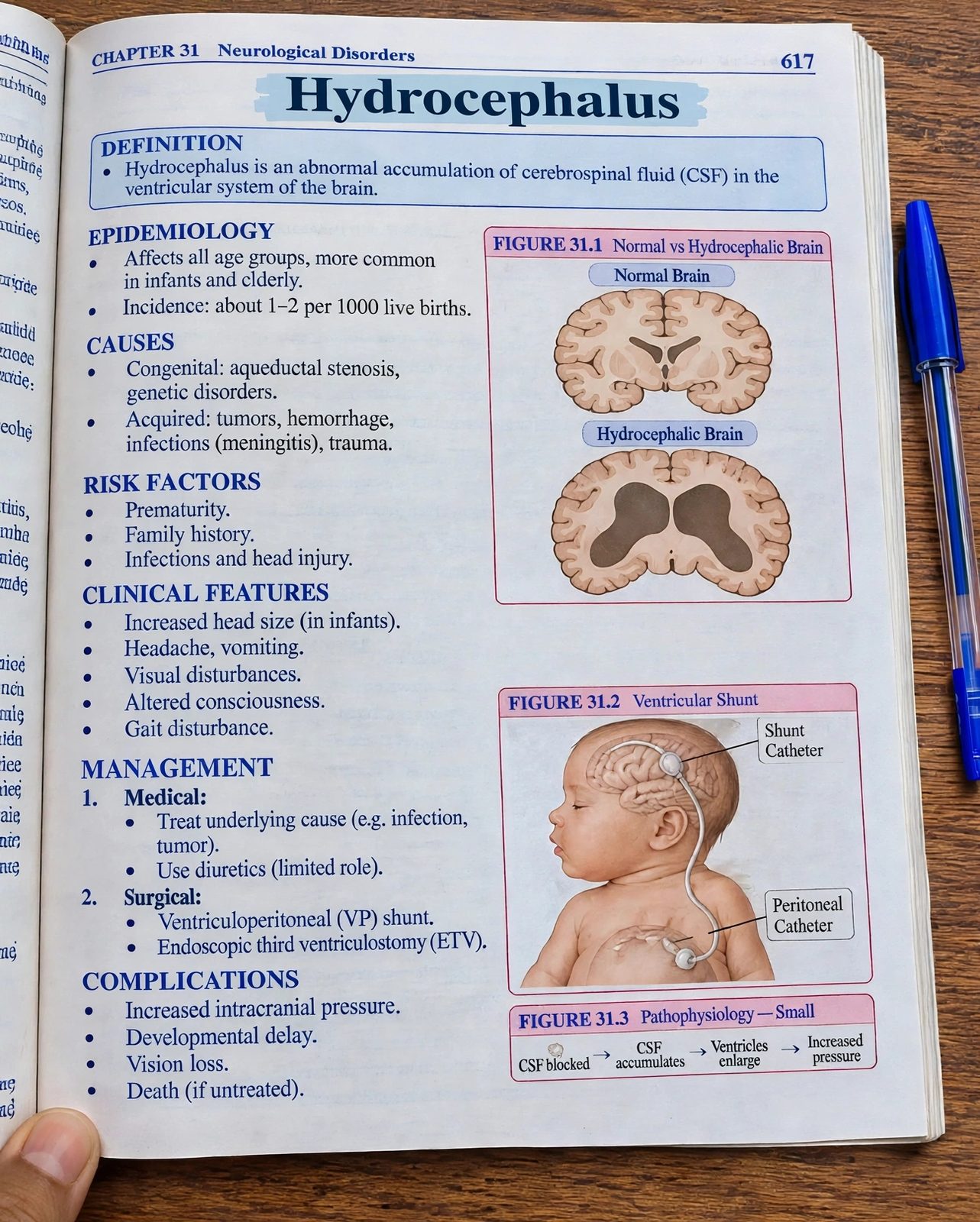
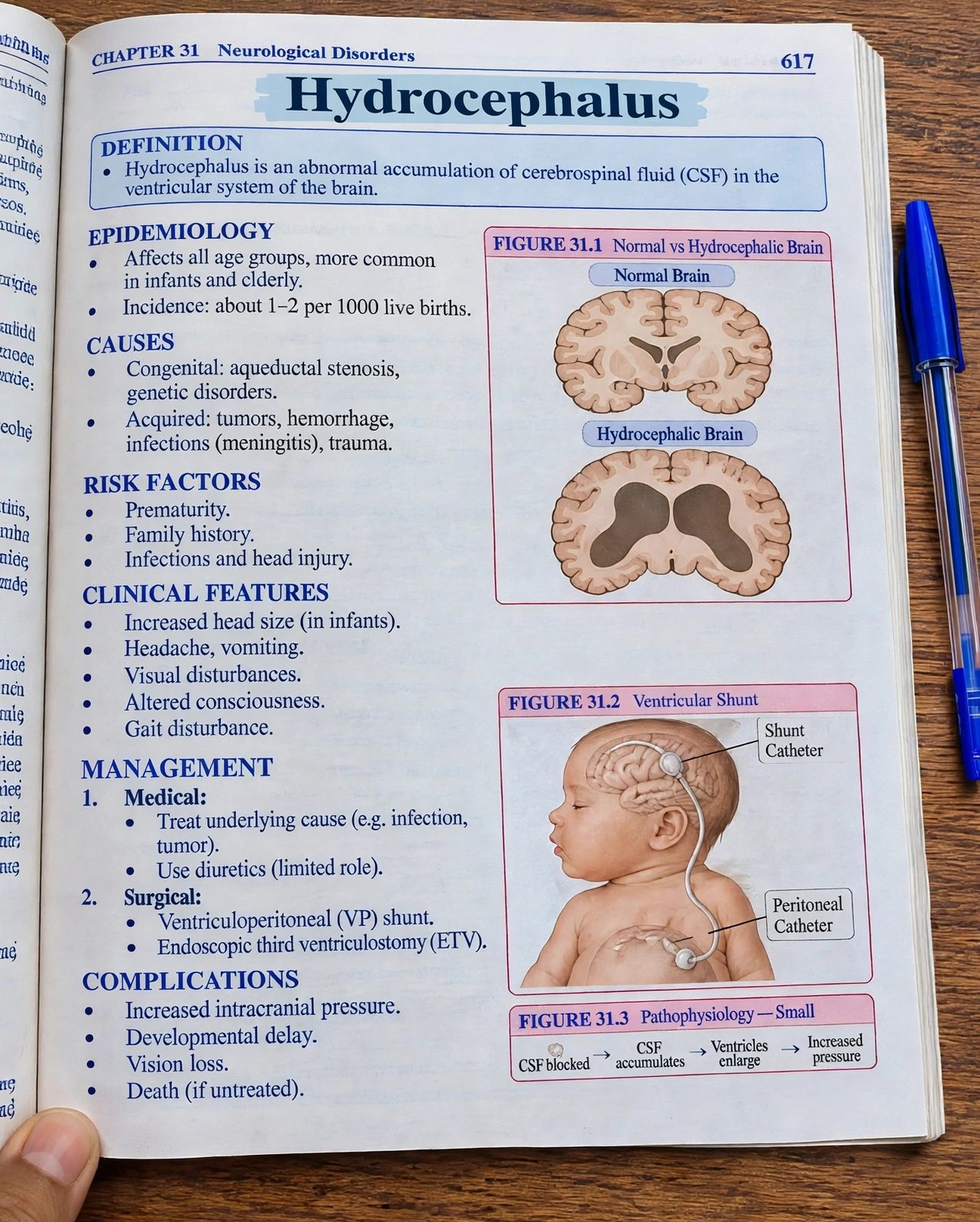
The Communicating Hydrocephalus, Non-Communicating / Obstructive Hydrocephalus, Normal Pressure Hydrocephalus, and Congenital Hydrocephalus represent four different patterns of cerebrospinal fluid (CSF) imbalance in the brain. The Communicating type is caused by impaired absorption of CSF, the Obstructive type is caused by a blockage in CSF flow, the Normal Pressure type occurs with enlarged ventricles but normal pressure in older adults, and the Congenital type is present at birth due to developmental abnormalities. Although these types belong to the same condition, each reflects a different cause, age group, and clinical problem. The Communicating Hydrocephalus is one of the most common patterns seen after infection or bleeding in the brain. Its CSF flows freely through the ventricles but is not absorbed properly by the arachnoid granulations. The ventricles become enlarged because CSF accumulates when reabsorption fails. Its causes include meningitis, subarachnoid haemorrhage, and impaired absorption after head injury. Compared with the other three types, the Communicating type is considerably more related to a failure of absorption than to a physical blockage. The Non-Communicating / Obstructive Hydrocephalus offers a more direct blockage interpretation of hydrocephalus. Its CSF flow is blocked inside the ventricular system, most commonly at the aqueduct of Sylvius or the outlets of the fourth ventricle. Its causes include aqueductal stenosis, brain tumours, cysts, and haemorrhage. Its ventricles enlarge upstream of the blockage, while the ventricles beyond the blockage remain normal in size. Compared with the Communicating type, the Obstructive type lacks the same free flow of CSF, but it offers a more clearly localised site of obstruction and a more urgent rise in intracranial pressure. The Normal Pressure Hydrocephalus introduced a more chronic and subtle approach to the condition, mainly in older adults. Its enlarged ventricles, normal CSF pressure, and gradual onset made it suitable for confusion with normal ageing or dementia. Depending on the patient, it presents with the classic triad of gait disturbance, dementia, and urinary incontinence. Compared with the Obstructive type, the Normal Pressure type placed greater emphasis on slow functional decline, walking problems, and memory loss rather than acute headache and vomiting. The Congenital Hydrocephalus was particularly distinctive because it combined developmental abnormality with early and visible head enlargement. Its large head, bulging fontanelle, and delayed development made it an easily recognised condition in infants. Depending on the cause, it was associated with aqueductal stenosis, spina bifida, Chiari malformation, and intrauterine infections. Its early onset, rapidly increasing head circumference, and effect on brain development made it especially important for early diagnosis. Compared with the Normal Pressure type, the Congenital type offered a more obvious physical sign in the form of macrocephaly and a particularly urgent need for early surgical treatment. In terms of severity, the Obstructive Hydrocephalus was comfortably ahead of the other three, with its sudden blockage delivering considerably more rapid pressure rise and risk of deterioration. The Congenital type provided a progressive enlargement of the head and developmental delay, while the Normal Pressure type offered a slower decline with a more gradual loss of walking and memory. The Communicating type was more focused on balanced, generalised ventricular enlargement than on a sudden crisis. Their different causes and sites of CSF problem created very different clinical pictures, even though they shared the same broad condition of CSF accumulation. Clinical features and presentation also separated these types. The Obstructive type's blocked flow and raised pressure made it the most acute and demanding presentation, with headache, vomiting, papilloedema, and altered consciousness. The Communicating type offered generalised features of raised pressure and a more gradual onset. The Normal Pressure type prioritised gait disturbance and cognitive change, making it better suited to slow outpatient assessment, while the Congenital type combined increased head size with irritability, poor feeding, sunset eyes, and delayed milestones. Their management reflected four different priorities. The Communicating type featured medical treatment of the underlying cause with surgical shunting when needed, while the Obstructive type provided a more direct surgical approach with removal of the blockage or endoscopic third ventriculostomy. The Normal Pressure type emphasized careful assessment, CSF tap test, and ventriculoperitoneal shunt in selected patients. The Congenital type offered early ventriculoperitoneal shunt placement with a strong emphasis on monitoring head growth, shunt function, and developmental support. Among these four, the Congenital type was the most dependent on long-term follow-up for shunt complications and development. Ultimately, these four types represent different strengths of understanding in hydrocephalus. The Communicating Hydrocephalus stands out for its absorption failure, the Non-Communicating / Obstructive Hydrocephalus for its clear blockage and acute pressure rise, the Normal Pressure Hydrocephalus for its chronic triad in older adults, and the Congenital Hydrocephalus for its early onset and visible head enlargement. The Obstructive type is the clear acute emergency, the Communicating type offers a balanced picture of generalised enlargement, the Normal Pressure type suits careful assessment in the elderly, and the Congenital type is the strongest example of why early detection and lifelong follow-up matter. Want me to make this shorter for an exam answer?
More View at a Glance
View all
STAGE OF FETAL DEVELOPMENT
Reproductive