
Overview
Absence seizures are a type of generalised seizure in which a person briefly loses awareness, usually for less than 15 seconds. They stare blankly, stop what they are doing, and then carry on as if nothing happened, often unaware that anything occurred. They used to be called petit mal seizures.
They are most common in children aged 4 to 14, particularly girls, and often happen many times a day. Because they are so brief, they are frequently mistaken for daydreaming or inattention, and may first come to notice as problems with schoolwork. Most children with childhood absence epilepsy grow out of it by adolescence.
When to get urgent help
Seek emergency help if a seizure lasts more than five minutes, if absences come one after another without recovery (absence status), or if a first convulsive seizure happens.
Causes and risk factors
Absence seizures are usually caused by genetic factors that affect how brain cells communicate. Often there is a family history of epilepsy. They are rarely caused by brain injury or structural problems.
Triggers include:
- Hyperventilation (fast, deep breathing)
- Flashing lights in some people
- Tiredness and lack of sleep
- Missing medication
How it develops (pathophysiology)
Normal brain activity and consciousness
The brain works through billions of nerve cells (neurons) that communicate with electrical impulses and chemical messengers. Most of the time, neurons fire in a varied, unsynchronised way, which allows different brain areas to process different information at once. Consciousness depends on constant two-way communication between the cerebral cortex, the outer layer responsible for thinking and awareness, and the thalamus, a pair of relay stations deep in the brain that pass sensory information to the cortex and regulate alertness.
These two structures are linked in loops called thalamocortical circuits. Three main groups of neurons take part:
- Cortical pyramidal neurons, which send excitatory signals down to the thalamus
- Thalamic relay neurons, which send excitatory signals back up to the cortex
- Neurons of the thalamic reticular nucleus, a thin shell around the thalamus, which release the inhibitory messenger GABA onto the relay neurons and act as a pacemaker
During normal deep sleep, this circuit naturally produces slow, rhythmic waves called sleep spindles. The same circuit, when it misfires during wakefulness, generates absence seizures.
What goes wrong
Absence seizures arise when the thalamocortical circuit switches suddenly into an abnormal, highly synchronised rhythm. Several mechanisms contribute:
- T-type calcium channels. Thalamic neurons contain special low-threshold calcium channels (T-type channels, encoded by genes such as CACNA1H and CACNA1G). When these neurons are briefly inhibited and then released, the channels open and produce a burst of firing called a low-threshold calcium spike. In absence epilepsy, these channels are more active or more numerous, making burst firing easier.
- GABA inhibition. GABA released by reticular neurons hyperpolarises (makes more negative) the relay neurons. Paradoxically, this priming of T-type channels makes the next burst more likely. Changes in GABA-A and GABA-B receptors, and in the transport of GABA, are found in many genetic forms.
- Cortical hyperexcitability. Studies in humans and animal models suggest that seizures often begin in a focal area of the cortex, particularly the frontal and somatosensory regions, which then drives the thalamus into synchrony.
- Genetic predisposition. Many children have a family history of epilepsy. Variants in genes for calcium channels, GABA receptors (such as GABRG2 and GABRA1) and the glucose transporter GLUT1 (SLC2A1) have been identified, although most cases involve several genes together rather than one single change.
How a seizure unfolds
- A burst of activity starts in the cortex or thalamus.
- Cortical neurons excite reticular thalamic neurons, which release GABA onto relay neurons.
- The relay neurons are inhibited, which resets their T-type calcium channels.
- When inhibition wears off, the relay neurons fire a burst back to the cortex.
- The cortex fires again, and the cycle repeats about three times a second.
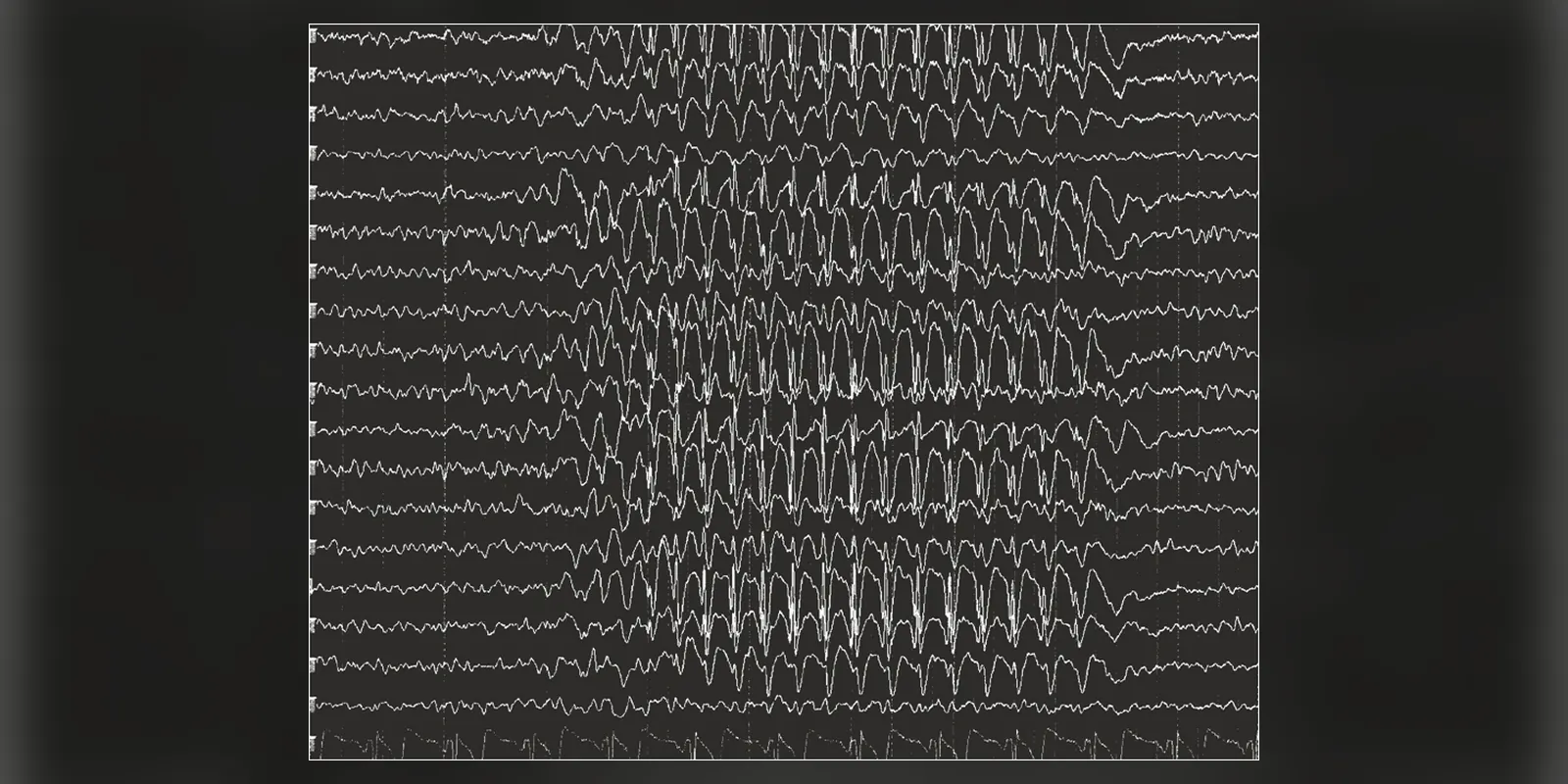
On an EEG this cycle is seen as 3 Hz spike-and-wave discharges: the spike represents synchronised excitation and the wave represents synchronised inhibition. Because the whole thalamocortical network is locked into this rhythm, normal information processing is interrupted and consciousness is lost. The seizure stops abruptly when the circuit desynchronises, possibly because of changes in ion concentrations or activation of other inhibitory mechanisms, and normal activity resumes at once.
Why the symptoms happen
- Blank stare and unresponsiveness reflect the temporary interruption of thalamocortical communication; the person is awake but cannot process or respond to the world.
- Sudden start and stop occur because the circuit switches in and out of the abnormal rhythm within a fraction of a second.
- No confusion afterwards is because neurons are not exhausted; unlike a tonic-clonic seizure, there is no prolonged spread of excitation and no post-seizure depression of brain activity.
- Eyelid fluttering, lip smacking and small hand movements (automatisms) arise from brief activation of motor areas or release of simple movement patterns from higher control.
- Triggering by hyperventilation occurs because fast breathing lowers carbon dioxide in the blood, making blood vessels in the brain narrow and blood alkaline. These changes increase neuronal excitability and favour synchronised firing.
- More episodes when tired occur because sleep deprivation shifts the thalamocortical system towards sleep-like rhythms.
How complications develop
Because absences can occur many times a day, children miss small but frequent pieces of information. Over weeks this adds up to gaps in learning, which can be mistaken for poor concentration. Repeated seizures may also be associated with underlying differences in attention networks, which is why attention difficulties are more common even when seizures are controlled.
In some people the same tendency to synchronised firing extends to motor systems, producing generalised tonic-clonic seizures or myoclonic jerks, especially in juvenile forms. Rarely, absences become continuous (absence status epilepticus), producing a prolonged confused state.
How treatment acts on the mechanism
- Ethosuximide blocks T-type calcium channels in thalamic neurons, directly preventing the bursts that sustain the rhythm. It works well for absences but does not protect against tonic-clonic seizures.
- Sodium valproate has several actions, including reducing T-type calcium currents, increasing GABA levels and blocking sodium channels, which explains its broad effect across seizure types.
- Lamotrigine reduces excitatory glutamate release by acting on sodium channels.
- Some medicines, such as carbamazepine, phenytoin, gabapentin and vigabatrin, can increase GABA-B activity or otherwise favour thalamic burst firing and may worsen absences.
- In GLUT1 deficiency, the brain cannot get enough glucose; a ketogenic diet provides ketones as an alternative fuel and can control seizures.
As the brain matures through adolescence, thalamocortical circuits change, which is one reason many children outgrow childhood absence epilepsy.
Types
- Typical absences: sudden onset and end, lasting under 15 seconds, with 3 Hz spike-and-wave on EEG
- Atypical absences: slower onset and recovery, often with changes in muscle tone; associated with other epilepsy syndromes and developmental problems
- Absences with eyelid myoclonia: rapid eyelid jerking
- Syndromes include childhood absence epilepsy, juvenile absence epilepsy and juvenile myoclonic epilepsy
Signs and symptoms
- Sudden blank stare
- Stopping speaking or moving mid-activity
- No response when spoken to
- Fluttering eyelids, lip smacking, chewing or small hand movements
- Instant return to normal, often without memory of the episode
- Many episodes a day, sometimes dozens or hundreds
People do not fall down or convulse during typical absences.
Teachers may notice a child who seems to 'switch off', loses their place when reading aloud, or misses instructions. Parents may see the child pause mid-sentence and then continue exactly where they left off. Episodes are more frequent when the child is tired, unwell or sitting quietly, and less frequent during active play.
How it is diagnosed
- Description from parents, teachers or witnesses; filming an episode on a phone is very helpful
- Hyperventilation test: asking the child to breathe deeply for three minutes often triggers a seizure in clinic
- EEG showing characteristic spike-and-wave patterns confirms the diagnosis
- MRI is only needed for atypical features
- Blood tests occasionally, for example glucose transporter testing in very early-onset cases
Possible complications
- Learning and attention difficulties from missed information
- Injury if a seizure happens while swimming, cycling or crossing roads
- Development of other seizure types, such as tonic-clonic seizures, in some people
- Social and emotional effects
Goals of treatment
The aim is to stop seizures completely with the fewest side effects, so that learning, safety and quality of life are not affected.
Medicines
Anti-seizure medicines are effective in most children:
- Ethosuximide is often the first choice for childhood absence epilepsy
- Sodium valproate is effective, particularly if tonic-clonic seizures also occur, but is avoided in girls and women who could become pregnant because of risks to the unborn baby
- Lamotrigine is an alternative
Some medicines used for other seizure types, such as carbamazepine, can make absences worse.
Other treatments
- Good sleep routines
- Informing school about the diagnosis and what to look for
- Supervision during swimming and bathing
- Ketogenic diet in rare drug-resistant cases
Children usually do not need to be excluded from sport or school trips. A simple care plan shared with the school explains what an absence looks like, how to record it and when to call parents. Recording the number of episodes in a diary helps doctors judge whether treatment is working.
Living with it and prevention
Absence seizures cannot be prevented, but triggers can be reduced by regular sleep, taking medication as prescribed and avoiding hyperventilation. Most children can take part in normal activities with sensible safety measures.
Teenagers should know that alcohol, recreational drugs and late nights can make seizures more likely. Supporting a child's confidence and explaining the condition to friends can reduce embarrassment and worry.
Monitoring and follow-up
Children are reviewed regularly to check seizure control, side effects, growth and school progress. Repeat EEGs may be used to assess control. If seizures stop for around two years, doctors may discuss gradually reducing medication.
Outlook
Childhood absence epilepsy usually has a good outlook, and many children outgrow it by their teenage years. Juvenile absence epilepsy is more likely to continue into adulthood but is usually well controlled.
Special considerations
- Girls and women of childbearing potential: medicine choice must consider pregnancy risks
- Driving: teenagers with ongoing seizures must follow local driving rules
- Schools: teachers should be told about the condition
Teenagers taking some anti-seizure medicines need advice about contraception, because certain medicines interact with hormonal contraceptives and some carry pregnancy risks.